Examples
Five studies of the kind MolAgent prepares and runs, from five application areas: the question, the system and the plan of calculations. The structures were built for this page with RDKit, ASE and Packmol and checked for composition, connectivity and geometry. They are starting points, not results.
Batteries and electrolytes
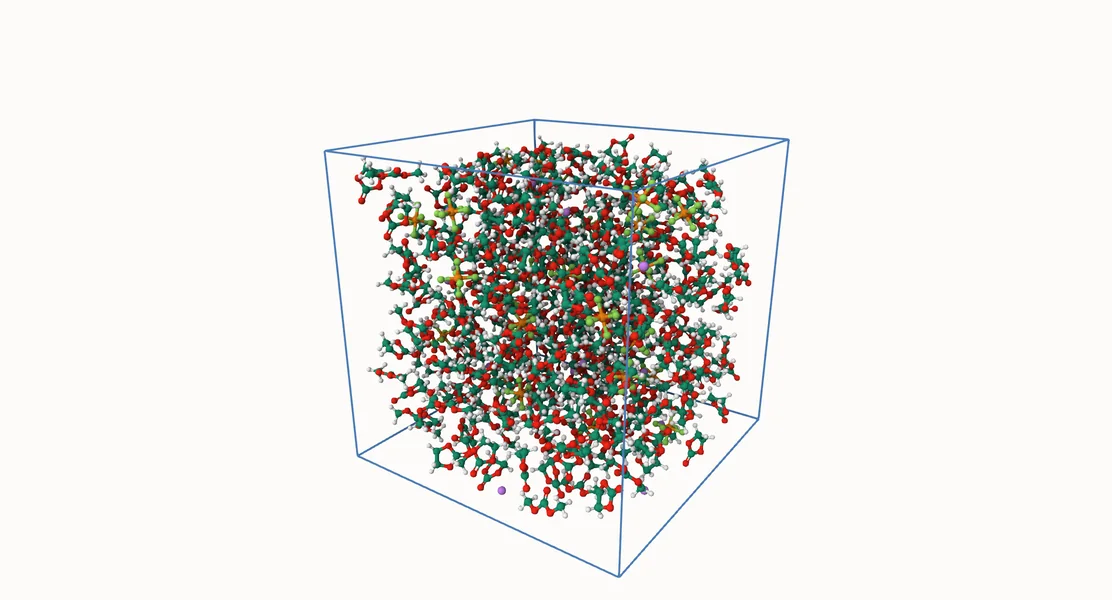
Li+ solvation and transport in a carbonate electrolyte
How are lithium ions solvated in 1 M LiPF6 in EC:DMC, a standard reference electrolyte in lithium-ion battery research, and how fast do the ions move?
- Composition
- 24 LiPF6, 180 ethylene carbonate, 142 dimethyl carbonate (EC:DMC 1:1 by volume)
- Size
- 3,696 atoms, packed in a cubic box of 34.2 Å
- Model
- OPLS-AA, ionic charges scaled by 0.8
Plan
- Build EC, DMC and PF6− and pack the box with Packmol.
- Assign OPLS-AA parameters, with ionic charges scaled to account for electronic polarisation.
- Equilibrate under NPT at 298 K and check the density against experiment.
- Run NVT production; compute Li–O and Li–F radial distribution functions and the coordination numbers of EC, DMC and PF6−.
- Compute diffusion coefficients from mean-square displacements, with a finite-size correction, and the ionic conductivity from the collective displacement of the ions.
- Check the preferred solvation shell against DFT binding energies of small Li+ clusters.
- Packmol
- LAMMPS
- OPLS-AA
- MDAnalysis
- ORCA
md/in.npt, NPT equilibration in LAMMPS# 1 M LiPF6 in EC:DMC (1:1 v/v), OPLS-AA with scaled ionic charges
units real
atom_style full
boundary p p p
pair_style lj/cut/coul/long 12.0
pair_modify mix geometric tail yes
kspace_style pppm 1.0e-5
bond_style harmonic
angle_style harmonic
dihedral_style opls
improper_style cvff
special_bonds lj/coul 0.0 0.0 0.5
read_data ../build/system.data
thermo_style custom step temp press density pe etotal
thermo 1000
velocity all create 298.15 81273 dist gaussian
fix 1 all npt temp 298.15 298.15 100.0 iso 1.0 1.0 1000.0
timestep 1.0
run 5000000
write_data npt.dataCatalysis and surfaces
Intermediates of CO2 electroreduction on Cu(111)
Where and how strongly do the intermediates of CO2 reduction bind on copper, and which proton–electron transfer step sets the limiting potential for reduction to CO and beyond?
- Surface
- Cu(111), p(6×6), four layers with the bottom two fixed, 20 Å of vacuum
- Adsorbates
- Three CO* and one COOH* on top sites, three H* in fcc hollows
- Size
- 157 atoms
Plan
- Optimise the bulk lattice constant with the chosen functional, here PBE with D3(BJ) dispersion.
- Converge the slab model: number of layers, k-point mesh, plane-wave cut-off and vacuum.
- Screen adsorption sites for COOH*, CO*, CHO*, COH* and H*, first with a machine-learned potential, then with DFT. Check that CO prefers the top site, as observed experimentally; GGA functionals tend to favour hollow sites.
- Compute the vibrational frequencies of the adsorbates for zero-point energies and entropies.
- Build the free-energy diagram with the computational hydrogen electrode and find the limiting potential.
- Compute activation barriers for the key proton–electron transfer steps, with explicit water at the surface: the limiting potential is a thermodynamic quantity and does not identify the rate-determining step.
- Test how the result depends on coverage and on implicit solvation.
- VASP
- ASE
- pymatgen
- MACE
coads/INCAR, relaxation of the co-adsorbed configuration in VASPSYSTEM = CO*, COOH* and H* on Cu(111) p(6x6), 4 layers, bottom 2 fixed
PREC = Accurate
ENCUT = 450
GGA = PE
IVDW = 12 ! D3(BJ)
ISMEAR = 1
SIGMA = 0.10
EDIFF = 1E-6
EDIFFG = -0.02
IBRION = 2
NSW = 300
ISIF = 2
LDIPOL = .TRUE.
IDIPOL = 3
LREAL = Auto
ALGO = Fast
NCORE = 8
LWAVE = .FALSE.
LCHARG = .FALSE.Semiconductors and 2D materials
Sulfur vacancies in monolayer MoS2
What does it cost to remove a sulfur atom from monolayer MoS2, which charge states of the vacancy are stable, and where do its levels lie in the band gap?
- Structure
- MoS2 monolayer, 9×9 supercell, one vacancy in the upper sulfur plane; in the viewer, its three Mo neighbours are shown in red
- Size
- 242 atoms, 18 Å of vacuum
Plan
- Converge the pristine monolayer: lattice constant, cut-off, k-points and vacuum.
- Relax the vacancy in its neutral and charged states, in supercells of increasing size.
- Compute formation energies as a function of the Fermi level and the sulfur chemical potential, with corrections for charged defects in two dimensions.
- Take the charge transition levels from the formation energies, with hybrid-functional band edges, and compare them with the defect states in the projected density of states.
- Extend to vacancy migration barriers and to passivation by oxygen.
- Quantum ESPRESSO
- VASP
- ASE
- pymatgen
vS/pw.relax.in, relaxation with Quantum ESPRESSO (cell and atomic positions omitted)&control
calculation = 'relax'
prefix = 'mos2_vS'
pseudo_dir = './pseudo'
forc_conv_thr = 1.0d-4
/
&system
ibrav = 0
nat = 242
ntyp = 2
ecutwfc = 50
ecutrho = 400
occupations = 'smearing'
smearing = 'mv'
degauss = 0.005
assume_isolated = '2D'
/
&electrons
conv_thr = 1.0d-8
mixing_beta = 0.3
/
&ions
/
ATOMIC_SPECIES
Mo 95.95 Mo.pbe-spn-rrkjus_psl.1.0.0.UPF
S 32.06 S.pbe-n-rrkjus_psl.1.0.0.UPF
K_POINTS automatic
3 3 1 0 0 0Pharmaceuticals and formulation
Ibuprofen binding to β-cyclodextrin
How strongly does β-cyclodextrin bind ibuprofen in water, in which orientation, and how does the answer change with the protonation state of the drug?
- Host
- β-cyclodextrin, seven glucose units
- Guest
- (S)-ibuprofen, inside the cavity; in the viewer, its carbon atoms are shown in orange
- Size
- 180 atoms before solvation
β-cyclodextrin coordinates adapted from the MobleyLab benchmark sets (BSD licence).
Plan
- Set up the neutral and the anionic form of ibuprofen; the carboxylic acid is deprotonated at physiological pH.
- Parameterise the guest with GAFF2 and RESP charges. For the host, compare GAFF2 with a carbohydrate force field (GLYCAM06 or q4md-CD): the choice of host parameters changes computed binding free energies. Solvate in explicit water.
- Place the guest in both orientations, with the carboxyl group at the wide or at the narrow rim, and equilibrate each complex.
- Compute the binding free energy by alchemical double decoupling, with Boresch restraints and their standard-state correction and, for the anion, a net-charge correction; and independently by umbrella sampling along the dissociation path.
- Compare with experimental binding constants and report the populations of the two orientations.
- AmberTools
- GAFF2
- GLYCAM06
- OpenMM
- PLUMED
- OpenFE
- alchemlyb
Polymers, resins and composites
Curing and glass transition of an epoxy network
How do the glass transition temperature and the elastic modulus of an amine-cured epoxy depend on the degree of cure?
- Resin
- 70 DGEBA (bisphenol A diglycidyl ether), RR, RS and SS stereoisomers in about 1:2:1
- Hardener
- 28 DETA (diethylenetriamine)
- Ratio
- Stoichiometric: 140 epoxide groups, 140 amine hydrogens
- Size
- 3,990 atoms, 40 Å box before compression
Plan
- Pack the monomers with Packmol and compress the mixture to liquid density under NPT.
- Parameterise the monomers, and the reaction templates before and after each bond forms, with a general force field.
- Crosslink with REACTER (LAMMPS
fix bond/react): when an amine nitrogen that still carries a hydrogen comes within a cut-off distance of a terminal epoxide carbon, the N–C bond forms, the epoxide C–O bond at that carbon breaks and the hydrogen moves from nitrogen to oxygen, giving a hydroxyl group. Primary and secondary amines react through separate templates, and the network is relaxed as it forms, up to conversions between 70 and 95 %. - Cool each network stepwise and take the glass transition temperature from the change of slope of density against temperature.
- Deform the networks uniaxially for Young's modulus and Poisson's ratio, and compare with experiment, accounting for the cooling and strain rates of simulation.
- Packmol
- LAMMPS
- REACTER
- MDAnalysis
build/packmol.inp, packing of the resin and hardenertolerance 2.0
filetype xyz
output mix_packmol.xyz
seed 4321
structure dgeba_rr.xyz
number 18
inside box 1.0 1.0 1.0 39.0 39.0 39.0
end structure
structure dgeba_rs.xyz
number 34
inside box 1.0 1.0 1.0 39.0 39.0 39.0
end structure
structure dgeba_ss.xyz
number 18
inside box 1.0 1.0 1.0 39.0 39.0 39.0
end structure
structure deta.xyz
number 28
inside box 1.0 1.0 1.0 39.0 39.0 39.0
end structureEarly access
MolAgent is in alpha. We are installing it with a small number of research groups now; a private beta opens in 2027. Write to us with the systems you study, the codes you use and the machines you compute on.
Or write to contact@molagent.ai.